
Overview
The Nikon D4 was flown by NASA astronauts across 35 identified missions, in NASA service 2011–2026, contributing 151,176 identifiable frames to the public astronaut photography archive. Traced by manufacturer serial number, at least 32 physical bodies have been identified in the public archive. The Nikon D4 is a 16.2 MP full-frame CMOS released by Nikon in January 2012.
Body S/N 2071140 is the most heavily documented in the archive, contributing 9,304 identifiable frames across 7 missions including ISS047, ISS050, ISS048. The other 31 identified bodies appear in more targeted mission windows, detailed below.
The Nikon D4 bodies were used with a range of lenses in orbit — the most-used include the 24.0 mm f/1.4, 28.0 mm f/1.4, and 50.0-500.0 mm f/4.5-6.3. The full lens roster appears in the sidebar.
The External High Definition Cameras
Some of these Nikon D4 bodies were not handheld cameras. They were the imaging core of NASA’s External High Definition Camera (EHDC): a camera and lens in an enclosure filled with dry nitrogen at atmospheric pressure, mounted on the outside of the station[9]. NASA selected a Nikon D4 with an AF-S Nikkor 28-300mm VR lens, a Kenko Teleplus MC7 AF 2.0 DGX doubler and an external stepper-motor zoom drive, giving an effective 56–600 mm[1][9]. Each assembly weighs about 28.6 lb[10]. Mounted on the station’s existing pan/tilt units, the EHDCs have full zoom, iris and focus control, and their still images are downlinked over the station’s network to an imagery server at JSC[9]. They were planned to film in 720p, take 16.2-megapixel stills, and support tasks such as inspecting Soyuz spacecraft before their return to Earth[11].
EHDC at a glance
NASA’s 2014 design planned EHDCs for 4 truss camera ports[1]; with the two booms added in 2018, NASA documents 6 positions that have carried an EHDC or its successor HD camera. This registry has so far identified 10 D4 bodies as EHDC cameras from NASA’s captions, naming 7 unit serials (S/N 1001, S/N 1002, S/N 1003, S/N 1004, S/N 1005, S/N 1008, S/N 1009) and 8 unit numbers (EHDC1, EHDC2, EHDC3, EHDC4, EHDC5, EHDC6, EHDC7, EHDC8), across 8,625 captioned photos. Because cameras were replaced over the years, the number of bodies can exceed the number of positions; which body served at which position is not recorded in the captions.
| Position | Location | History |
|---|---|---|
| Camera Port 9 | P1 truss, lower outboard | EHDC installed September 1, 2016; still in place in 2022[2][8] |
| Camera Port 8 | P1 truss, upper outboard | EHDC installed September 1, 2016; replaced by a wireless HD camera on March 23, 2022[2][8] |
| Camera Port 3 | S1 truss | EHDC in place before June 2018 (installation date not documented); replaced June 14, 2018; camera group replaced February 1, 2021[4][6][7] |
| Camera Port 13 | US Lab, starboard | HD camera installed February 1, 2021[6][7] |
| WIF 16 boom | near Harmony’s forward docking port | EHDC installed June 14, 2018 for commercial crew dockings[4] |
| WIF 17 boom | near Harmony’s forward docking port | EHDC installed June 14, 2018 for commercial crew dockings[4] |
Spacewalking astronauts installed and replaced the EHDCs over several years:
- September 1, 2016 — Jeff Williams installs the first EHDCs, at Camera Port 9 (P1 truss, lower outboard) and, with the crew ahead of schedule, Camera Port 8 (P1 truss, upper outboard)[2][11].
- October 20, 2017 — Randy Bresnik and Joe Acaba install an HD camera outside the station[3].
- June 14, 2018 — Drew Feustel and Ricky Arnold install EHDCs on the new WIF 16 and WIF 17 booms near Harmony’s forward docking port, for views of commercial crew dockings, and replace the EHDC at Camera Port 3[4].
- December 2018 — SpaceX CRS-16 carries EHDC assemblies to support a critical spacewalk planned for 2019[5].
- February 1, 2021 — Michael Hopkins and Victor Glover install an HD camera at Camera Port 13 (Lab starboard) and replace the Camera Port 3 camera group; both ports had been wired for EHDCs[6][7].
- March 23, 2022 — Raja Chari and Matthias Maurer replace the Camera Port 8 EHDC with a wireless HD camera that also serves as a Wi-Fi access point[8].
NASA’s captions on EHDC photographs name the unit that took them[12]. Matching those captions to the camera serial recorded in each photo identifies 10 Nikon D4 bodies as EHDC cameras, together accounting for 5,436 of the model’s 151,176 photographs from space in this registry. Unit names are shown exactly as the captions write them: the unit serial (“EHDC S/N”) and the unit number (“EHDC1”–“EHDC7”) are two different labels, and a camera may appear under both.
| Camera S/N | EHDC unit named in NASA captions | Photos from space | Years |
|---|---|---|---|
| 2071158 | EHDC S/N 1005 (2,055 captions, 2016–2026) EHDC2 (938 captions, 2021–2026) EHDC8 (2 captions, 2023) | 1,958 | 2016–2026 |
| 2071162 | EHDC S/N 1008 (1,190 captions, 2021–2026) EHDC7 (1,049 captions, 2021–2026) | 1,150 | 2021–2026 |
| 2071157 | EHDC S/N 1001 (768 captions, 2021–2026) EHDC3 (718 captions, 2021–2026) EHDC6 (1 caption, 2025) EHDC8 (3 captions, 2026) | 711 | 2021–2026 |
| 2071160 | EHDC S/N 1004 (670 captions, 2016–2022) EHDC1 (214 captions, 2018–2022) | 652 | 2016–2022 |
| 2071155 | EHDC S/N 1002 (372 captions, 2018–2020) | 355 | 2018–2020 |
| 2067548 | EHDC1 (341 captions, 2022–2026) | 314 | 2022–2026 |
| 2071159 | EHDC S/N 1009 (207 captions, 2018–2026) EHDC4 (61 captions, 2021–2026) | 195 | 2018–2026 |
| 2067546 | EHDC6 (8 captions, 2021–2024) | 84 | 2020–2024 |
| 2071161 | EHDC S/N 1008 (12 captions, 2020–2025) EHDC5 (10 captions, 2021–2025) | 11 | 2020–2025 |
| 2071156 | EHDC S/N 1003 (6 captions, 2017) | 6 | 2017 |
Direct links between the two labels. Some photos carry both labels in their own metadata, the unit serial in the User Comment field (“NASA EHDC S/N 1008”) and the unit number in the Image Description (“GMT048_EHDC7_1162”). Each such photo ties one unit serial to one unit number at that moment:
| Unit serial | Unit number | Camera | Photos with both | Dates | Examples |
|---|---|---|---|---|---|
| EHDC S/N 1004 | EHDC1 | D4 2071160 | 214 | 2018/04/19 to 2022/02/26 | ISS055-E-26913, ISS057-E-55462, ISS066-E-95463 |
| EHDC S/N 1008 | EHDC7 | D4 2071162 | 1,049 | 2021/02/26 to 2026/08/30 | ISS072-E-861975, ISS072-E-487421, ISS071-E-462185 |
| EHDC S/N 1001 | EHDC3 | D4 2071157 | 718 | 2021/03/11 to 2026/08/18 | ISS071-E-439629, ISS069-E-4825, ISS072-E-36306 |
| EHDC S/N 1005 | EHDC2 | D4 2071158 | 938 | 2021/03/11 to 2026/07/17 | ISS071-E-418230, ISS069-E-4821, ISS069-E-4822 |
| EHDC S/N 1009 | EHDC4 | D4 2071159 | 61 | 2021/04/23 to 2026/08/12 | ISS067-E-107529, ISS065-E-280824, ISS067-E-90378 |
| EHDC S/N 1008 | EHDC5 | D4 2071161 | 10 | 2021/04/24 to 2025/08/25 | ISS070-E-22098, ISS067-E-107094, ISS067-E-107093 |
| EHDC S/N 1005 | EHDC8 | D4 2071158 | 2 | 2023/11/11 to 2023/11/19 | ISS070-E-26585, ISS070-E-22097 |
| EHDC S/N 1001 | EHDC6 | D4 2071157 | 1 | 2025/01/26 | ISS072-E-571418 |
| EHDC S/N 1001 | EHDC8 | D4 2071157 | 3 | 2026/08/27 | ISS075-E-85138, ISS075-E-85136, ISS075-E-85139 |
The date each label first appears in the captions can be compared with the documented spacewalks. Several first appearances fall on, or within a month after, a day when NASA records installing or replacing an EHDC:
| Camera | Label | First caption | Documented spacewalk |
|---|---|---|---|
| D4 2071158 | EHDC S/N 1005 | 2016/09/16 | 15 days after 2016/09/01, first EHDCs installed at Camera Ports 9 and 8[2] |
| D4 2071160 | EHDC S/N 1004 | 2016/09/16 | 15 days after 2016/09/01, first EHDCs installed at Camera Ports 9 and 8[2] |
| D4 2071156 | EHDC S/N 1003 | 2017/10/20 | same day: 2017/10/20, HD camera installed outside the station[3] |
| D4 2071160 | EHDC1 | 2018/04/19 | — |
| D4 2071159 | EHDC S/N 1009 | 2018/06/14 | same day: 2018/06/14, EHDCs installed on the WIF 16 and WIF 17 booms; Camera Port 3 EHDC replaced[4] |
| D4 2071155 | EHDC S/N 1002 | 2018/06/24 | 10 days after 2018/06/14, EHDCs installed on the WIF 16 and WIF 17 booms; Camera Port 3 EHDC replaced[4] |
| D4 2071161 | EHDC S/N 1008 | 2020/11/17 | — |
| D4 2071162 | EHDC S/N 1008 | 2021/02/01 | same day: 2021/02/01, Camera Port 13 HD camera installed; Camera Port 3 camera group replaced[6][7] |
| D4 2071157 | EHDC S/N 1001 | 2021/02/02 | 1 day after 2021/02/01, Camera Port 13 HD camera installed; Camera Port 3 camera group replaced[6][7] |
| D4 2071162 | EHDC7 | 2021/02/26 | 25 days after 2021/02/01, Camera Port 13 HD camera installed; Camera Port 3 camera group replaced[6][7] |
| D4 2071157 | EHDC3 | 2021/03/11 | — |
| D4 2071158 | EHDC2 | 2021/03/11 | — |
| D4 2071159 | EHDC4 | 2021/04/23 | — |
| D4 2071161 | EHDC5 | 2021/04/24 | — |
| D4 2067546 | EHDC6 | 2021/08/25 | — |
| D4 2067548 | EHDC1 | 2022/03/23 | same day: 2022/03/23, Camera Port 8 camera replaced[8] |
Working hypothesis, not yet confirmed. Each pair of labels in the table above holds steady for years, but the “EHDC S/N” value is not unique: S/N 1008 on D4 2071161 (12 captions, 2020/11 to 2025/08) and D4 2071162 (1,190 captions, 2021/02 to 2026/08) carry the same serial over the same years. The “EHDC S/N” written in the User Comment therefore appears to be a camera setting that can be copied from one camera to another, not a unique assembly serial, and the unit number (“EHDC1” to “EHDC7”) is the more reliable identifier. Each camera that carries a unit number has one main number, the one on most of its captions (EHDC1, EHDC2, EHDC3, EHDC4, EHDC5, EHDC6, EHDC7). Main numbers have passed from one camera to another: EHDC1 passed from D4 2071160 (2018/04 to 2022/02) then D4 2067548 (2022/03 to 2026/08); the change coincides with a documented replacement on 2022/03/23[8]. That pattern suggests the numbers identify camera positions rather than cameras. A few captions file a camera under a second number at the same time (D4 2071157 as EHDC6 (1 caption); D4 2071157 as EHDC8 (3 captions); D4 2071158 as EHDC8 (2 captions, noted in the caption as EHDC2)), so a number may also mark a group of downloaded files rather than only a position. The cameras’ main numbers run to 7, while NASA’s records found so far document 6 positions, so the numbering may include a position not yet documented, or may not map one-to-one onto ports. No NASA document seen so far states what either label identifies, or which number belongs to which camera port.
Proposed numbers-to-ports (hypothesis). Each change of camera behind a unit number coincides with a documented replacement at one specific port, which suggests the following mapping. It is offered for testing, not as established fact.
| Number | Cameras with captions carrying it (first to last such caption) | Proposed port | Evidence |
|---|---|---|---|
| EHDC1 | D4 2071160 (2018/04 to 2022/02) D4 2067548 (2022/03 to 2026/08) | Camera Port 8 (P1 truss, upper outboard) | Its camera changed on March 23, 2022, the day NASA replaced the Camera Port 8 camera; its first camera appeared within weeks of the September 2016 installations at Camera Ports 8 and 9. Labelled photos checked: iss055e026913 and iss064e053180 (D4 2071160); Expedition 72 photos (D4 2067548).[2][8] |
| EHDC2 | D4 2071158 (2021/03 to 2026/07) | Camera Port 9 (P1 truss, lower outboard) | The same camera from 2016 to 2026, never replaced; NASA reports the Camera Port 9 camera still in place in 2022. Labelled photos checked: iss051e010470 (2017) and iss064e053184 (D4 2071158). Two November 2023 captions read “EHDC8 Files_1158 (EHDC2)”, still naming this camera as EHDC2.[2][8] |
| EHDC3 | D4 2071157 (2021/03 to 2026/08) | Camera Port 3 (S1 truss) | Its camera changed in June 2018 and February 2021, the two times NASA replaced the Camera Port 3 EHDC or camera group. The S/N 1003 camera, captioned only on October 20, 2017, the day an HD camera was installed, may have been the first camera there. Labelled photos checked: iss057e055409 and iss057e055411 (2018, D4 2071155); iss066e123340 (D4 2071157).[3][4][7] |
| EHDC4 | D4 2071159 (2021/04 to 2026/08) | WIF 16 or WIF 17 boom (one of the two) | Its camera (S/N 1009) first appears on June 14, 2018, the day EHDCs were installed on the new WIF 16 and WIF 17 booms near Harmony’s forward docking port. Which of the two booms is not recorded.[4] |
| EHDC7 | D4 2071162 (2021/02 to 2026/08) | Camera Port 13 (US Lab, starboard) | Its camera first appears on February 1, 2021, the day the Camera Port 13 HD camera was installed. Labelled photos checked: iss064e042059 and iss068e054895 (D4 2071162).[6][7] |
| EHDC5 | D4 2071161 (2021/04 to 2025/08) | not yet assigned | Likely among the two boom positions added in June 2018 and any position not yet documented. |
| EHDC6 | D4 2067546 (2021/08 to 2024/01) | not yet assigned | Likely among the two boom positions added in June 2018 and any position not yet documented. |
- Studer, V. (2014). International Space Station (ISS) External High Definition Camera Assembly (EHDCA). In-Space Inspection Technology Workshop, July 16, 2014. NASA NTRS 20140009959. https://ntrs.nasa.gov/citations/20140009959
- NASA. ISS Daily Summary Report – 09/01/2016 (EHDC installed at Camera Port 9, P1 Lower Outboard, and at Camera Port 8, P1 Upper Outboard). https://www.nasa.gov/blogs/stationreport/2016/09/01/iss-daily-summary-report-09-01-2016
- NASA Space Station blog (October 20, 2017). Expedition 53 Embarks upon Third and Final Spacewalk in October Series. https://www.nasa.gov/blogs/spacestation/2017/10/20/expedition-53-embarks-upon-third-and-final-spacewalk-in-october-series
- NASA. Space Station On-Orbit Status, 14 June 2018 – Spacewalk Complete (US EVA 51: WIF 16 and WIF 17 boom EHDC installation; CP3 EHDC and luminaire remove and replace), as reprinted by SpaceRef. https://spaceref.com/space-stations/nasa-space-station-on-orbit-status-14-june-2018-spacewalk-complete/
- NASA (2018). SpaceX CRS-16 Mission Overview (External High Definition Camera Assembly: flying external camera units to support a critical spacewalk planned for 2019). https://www.nasa.gov/wp-content/uploads/2018/07/spacex_crs-16_mision_overview_high_res_rev2.pdf
- NASA. ISS Daily Summary Report – 1/21/2021 (Ethernet connected for the EHDCs at Camera Port 3, S1, and Camera Port 13, Lab Starboard). https://www.nasa.gov/blogs/stationreport/2021/01/21/iss-daily-summary-report-1-21-2021/
- NASA. ISS Daily Summary Report – 2/01/2021 (US EVA 70, ISS Upgrades II: CP3 camera group remove and replace; CP13 HD camera installation). https://www.nasa.gov/blogs/stationreport/2021/02/01
- NASA (2022). NASA Astronauts Install the Ninth Wi-Fi Access Point outside Space Station. NASA NTRS 20220017031. https://ntrs.nasa.gov/citations/20220017031
- Muri, P., Runco, S., Fontanot, C., & Getteau, C. The High Definition Earth Viewing (HDEV) Payload. NASA Johnson Space Center (IEEE paper), section “New External High Definition Cameras” and Figure 12.
- Leidos / NASA (2018). External Wireless Communications (EWC) Coverage Expansion Boom Interface Control Document, CMC2-00781, NASA-CR-2018-220508, March 6, 2018, Figure 3-13. https://ntrs.nasa.gov/citations/20200002228
- NASASpaceFlight.com (September 2016). EVA-37 installs first external HD cameras and conducts TTCR retract task (secondary source). https://www.nasaspaceflight.com/2016/09/eva-37-first-external-hd-camera-ttcr-retract/
- NASA photo captions. EHDC photographs carry the unit in their caption, written either as “NASA EHDC S/N 1005” or as “GMT070_EHDC2 Files_1158” (unit number plus the last four digits of the camera serial); compiled from NASA’s published photographs by this registry.
Exemplar photographs
Additional representative frames captured by the Nikon D4 bodies in orbit. Full resolution is available at the linked NASA archives.
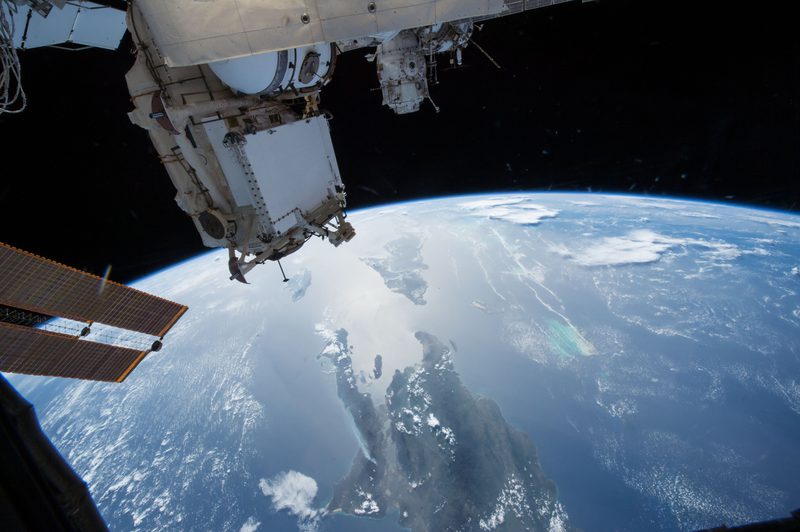
View of Earth from ISS Expedition 44
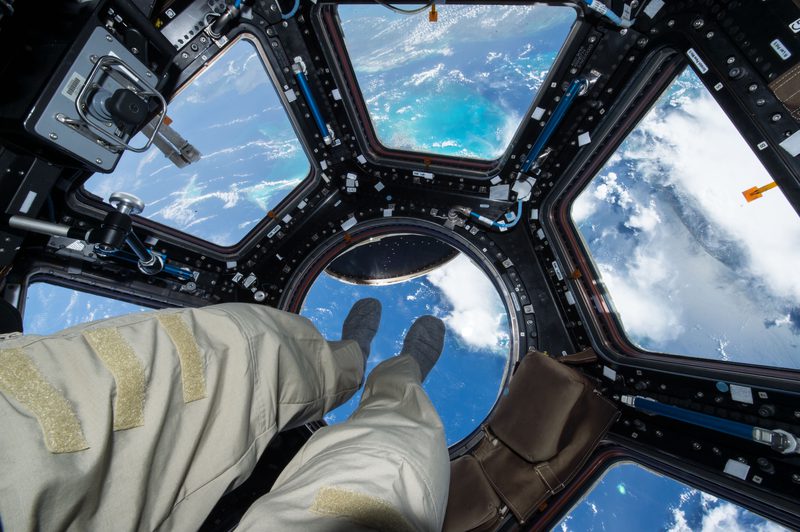
View through the cupola during ISS Expedition 44
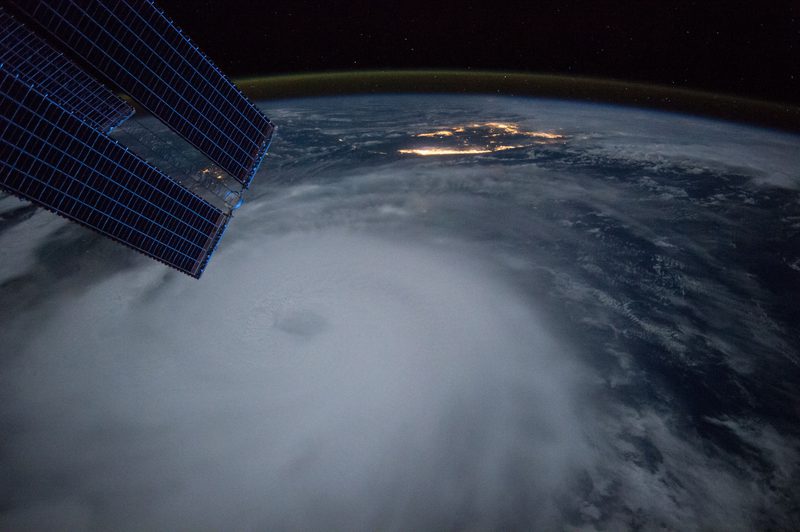
A view of Earth at night from International Space Station
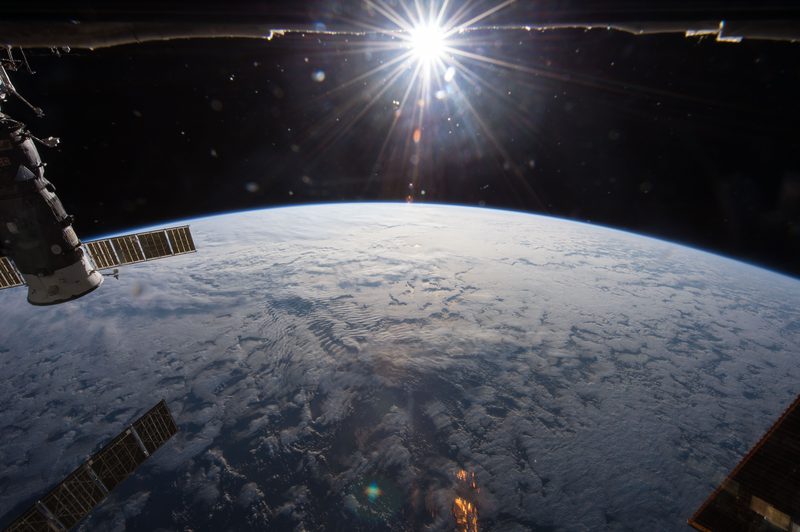
View of Earth and Sun from the International Space Station
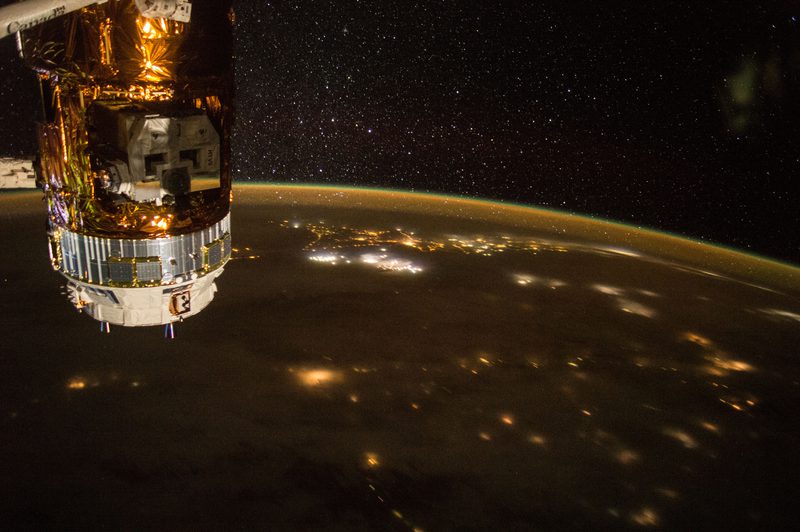
View of Earth and stars from the International Space Station
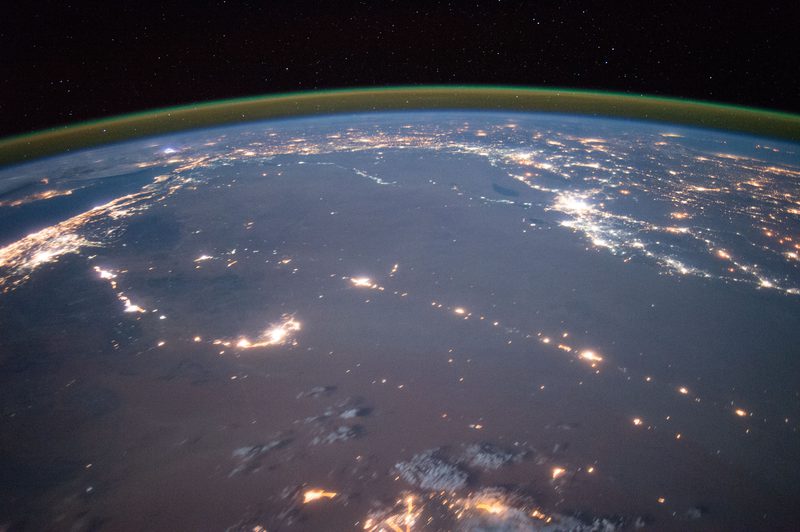
View of Earth and stars from the International Space Station
In NASA service
Nikon delivered NASA's D4 fleet in two waves. In 2013, Nikon supplied 38 D4 bodies together with 64 NIKKOR lenses and supporting accessories as the successor to the D2Xs on-orbit fleet.1 In 2016, Nikon delivered an additional 10 D4 bodies, bringing the total NASA D4 procurement to 48 bodies across 2013 and 2016.2 Nikon's own corporate record documents both deliveries specifically as Nikon D4 — not D4S — and NASA's Earth-observation camera taxonomy corroborates this, assigning code N6 to the Nikon D4 with no separate D4S code in the sequence, which runs D4 → D800E → D5.3 Some secondary photography reporting refers to the 2016 batch as D4S bodies; the primary Nikon and NASA records do not.
The 2013 delivery was the largest single-batch Nikon supply to the space station documented at that point, reflecting the ISS's transition from the Shuttle-era mixed platform to an era in which the station itself was the primary imaging platform. The D4 remained the primary NASA digital body until the D5 entered service in 2017.1
A 2017 imaging-science study of NASA's D3s and D4 workflow reports that astronauts capture 10,000 to 15,000 images per week from ISS and that cosmic-ray damage forces retirement of most cameras within six months to a year of orbital service. The study documents a characteristic pair-pixel damage pattern in D3s and D4 sensors whose underlying mechanism — sensor readout damage or inter-pixel leakage — the authors were unable to establish without returned hardware.4
- Nikon Corporation. “Nikon Z 9 goes to space: Space station astronauts receive Nikon's flagship full-frame mirrorless camera.” Press release, 7 February 2024.
- Nikon Corporation, 2017 corporate announcement documenting the 2016 supplementary delivery of ten additional D4 bodies to NASA.
- NASA Johnson Space Center, Earth-observation camera taxonomy assigning code
N6to the Nikon D4, with no separate D4S entry in the sequenceN6(D4) → D800E → D5. - Moser, Kevin. “CRDIR: Cosmic Ray Damaged Image Repair for DSLR Cameras.” Rochester Institute of Technology, Center for Imaging Science Senior Project, May 2017.
Commercial availability
Nikon D4 on the used market
The bodies documented in this registry are the specific units NASA sent to orbit. The commercial market carries the same Nikon D4 model at accessible prices for collectors, photographers, and researchers. Listings shown are the same model, not the specific bodies flown.
CARES LLC participates in the eBay Partner Network. Purchases via this link may generate commission at no additional cost to you. The listings shown are the same Nikon D4 model used by NASA, not the specific bodies flown.
Bodies identified
Each identifiable body of the Nikon D4 that appears in NASA's public astronaut photography archive, sorted by frame count.