
Overview
The Nikon D5 was flown by NASA astronauts across 26 identified missions, in NASA service 2017–2026, contributing 272,137 identifiable frames to the public astronaut photography archive. Traced by manufacturer serial number, at least 53 physical bodies have been identified in the public archive. The Nikon D5 is a 20.8 MP full-frame CMOS released by Nikon in January 2016.
Body S/N 3502363 (NASA SN 3502363) is the most heavily documented in the archive, contributing 12,190 identifiable frames across 5 missions including ISS055, ISS054, ISS053. The other 52 identified bodies appear in more targeted mission windows, detailed below.
The Nikon D5 bodies were used with a range of lenses in orbit — the most-used include the 24.0 mm f/1.4, 28.0 mm f/1.4, and 17.0-35.0 mm f/2.8. The full lens roster appears in the sidebar.
Exemplar photographs
Additional representative frames captured by the Nikon D5 bodies in orbit. Full resolution is available at the linked NASA archives.
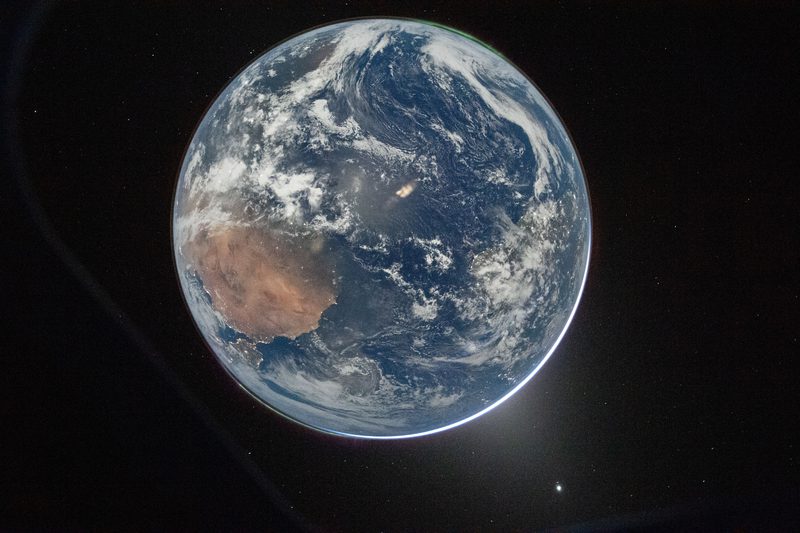
A view of Earth taken by NASA astronaut Reid Wiseman from the Orion spacecraft.
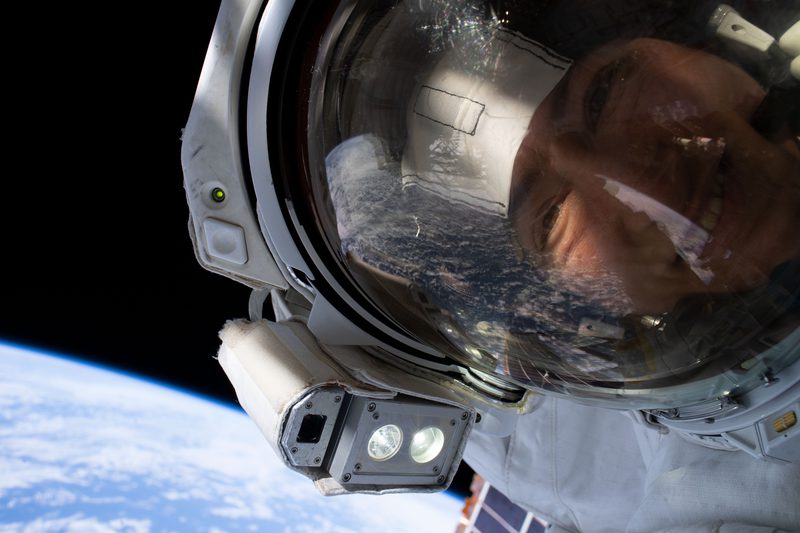
Astronaut Christina Koch selfie during all woman spacewalk
In NASA service
On 25 August 2017, Nikon Corporation announced that NASA had placed an order for 53 Nikon D5 digital SLR cameras, intended both for astronaut ground training and for still photography inside and outside the International Space Station.1 As with the D3S procurement eight years earlier, Nikon stated that no special hardware modifications were made — the flight units were the same D5 bodies available commercially. The first flight batch of 10 D5 bodies reached the ISS in November 2017 aboard Orbital ATK's OA-8 Cygnus resupply mission, with the balance of the 53-camera order supporting ground training, reserves, and subsequent orbital rotations.1
Although the D5 body itself was physically standard, NASA loaded modified firmware onto its flight units — the same pattern Nikon would later document explicitly for the Z 9. In December 2023, astronaut Don Pettit described the ISS Nikon inventory of the D5 era as “12 to 15” D5 bodies at any one time, supported by a full lens range from an 8 mm fisheye to a 1200 mm prime, and identified two flight-specific firmware modifications: extended in-camera noise reduction running down to 1/500 s rather than the commercial 1-second threshold — to counter cosmic-ray sensor damage at fast shutter speeds — and a modified RAW file numbering scheme to prevent duplicate frame numbers across a mission's several hundred thousand exposures. Pettit stated that the ISS Nikon fleet is rotated back to Earth roughly every six months, with the most radiation-damaged units retired from service.2
The D5 began transitioning out of primary duty on 30 January 2024, when Nikon and NASA delivered the first Z 9 bodies to the ISS aboard Northrop Grumman's CRS-20 resupply mission. Nikon's own 2024 announcement describes the incoming Z 9 bodies as replacing the “current inventory of Nikon D6 and D5 DSLR cameras on the space station,” consistent with a mixed D5/D6 late-life fleet in the years immediately preceding the Z 9 transition.3
- Nikon Corporation. “Nikon Corporation to supply 53 D5 digital SLR cameras to NASA.” Press release, 25 August 2017.
- Growcoot, Matt. “Nikon Makes Special Firmware for Astronauts to Block Galactic Cosmic Rays in Photos.” PetaPixel, 6 December 2023.
- Nikon Corporation. “Nikon Z 9 goes to space: Space station astronauts receive Nikon's flagship full-frame mirrorless camera.” Press release, 7 February 2024.
Commercial availability
Nikon D5 on the used market
The bodies documented in this registry are the specific units NASA sent to orbit. The commercial market carries the same Nikon D5 model at accessible prices for collectors, photographers, and researchers. Listings shown are the same model, not the specific bodies flown.
CARES LLC participates in the eBay Partner Network. Purchases via this link may generate commission at no additional cost to you. The listings shown are the same Nikon D5 model used by NASA, not the specific bodies flown.
Bodies identified
Each identifiable body of the Nikon D5 that appears in NASA's public astronaut photography archive, sorted by frame count.